“Ah! I see it now.”
The tutor draws a line, highlights a clue or connects two pieces of information. Your child can now follow why the solution works.

For capable children who study hard, practise diligently and understand familiar methods, yet hesitate when questions look different. CurioMITY helps children discover the hidden relationships that make unfamiliar problems easier to begin.
Story led, hands on adventures · Ages 7 to 12 · Singapore developed

They do their assessment papers, attend lessons and can solve familiar Math questions. But when the same concepts appear differently, they may not recognise where to begin.
CurioMITY isn't a replacement for excellent teachers, school or tuition. It is a complementary space to develop the independent thinking that makes existing knowledge more useful.
See how the training works ↗CurioMITY complements school and tuition. It is not a remedial Math programme or a diagnostic assessment.
A good explanation can help a child understand a solution. The next challenge is recognising a useful relationship when no one has pointed it out.
The tutor draws a line, highlights a clue or connects two pieces of information. Your child can now follow why the solution works.
Your child completes familiar questions. You feel reassured that the lesson has been understood.
The familiar clue is gone. Can your child discover a useful relationship before someone reveals it again?
Both matter. Teaching gives children knowledge and approaches. Children also need opportunities to practise noticing when and how to use them. That is the ability we call Seeing Math.
Experience that difference yourself in the two questions below.
Try each question before revealing the explanation. What must a child notice before deciding what to calculate?
Three triangles are shaded. How many more must be shaded to make 4/9 of the whole figure shaded?

Where would your child begin if no one drew the extra lines?
Five added vertical lines reveal 18 equal triangles. Four ninths of 18 is 8. Three triangles are already shaded, so 5 more must be shaded.
A child may know how to calculate a fraction of a number. Here, they first have to discover what the whole is made of.
The average weight of some boys was 39 kg. Arnold joined the group and the average became 42 kg. If Arnold weighed 66 kg, how many boys were there at first?
The formula is familiar. But the number of boys is missing. What can your child work out from the relationships?
The original boys’ average is 3 kg below the new average. Their combined shortfall is 3 kg for each original boy.
Arnold is 24 kg above the new average. His excess balances the original boys’ combined shortfall.
Eight shortfalls of 3 kg balance Arnold’s 24 kg excess. There were eight boys at first.
Knowing the formula matters. Seeing these relationships gives the child a way to use it.
Looking beyond the information given to discover hidden information and relationships that help you work out how to begin.
If you opened the explanations, you may have had your own “aha”: now the added lines or unstated differences make sense.
But would understanding these two reveals tell you what to look for in the next unfamiliar question? That is the same gap a child can face after a clear lesson. Seeing a solution once and practising how to discover a starting point are different learning experiences.
Before choosing a calculation, a child needs to notice what matters and how the information connects. CurioMITY gives children a place to practise that thinking through stories and real materials.
A short simulated lesson introduces a challenge and shows an approach. Your child then meets changing missions that ask them to discover useful information and decide what to try.
The aim is to build the noticing and reasoning that help children use what they learn in school and tuition when a question looks unfamiliar.
See what one parent discovered →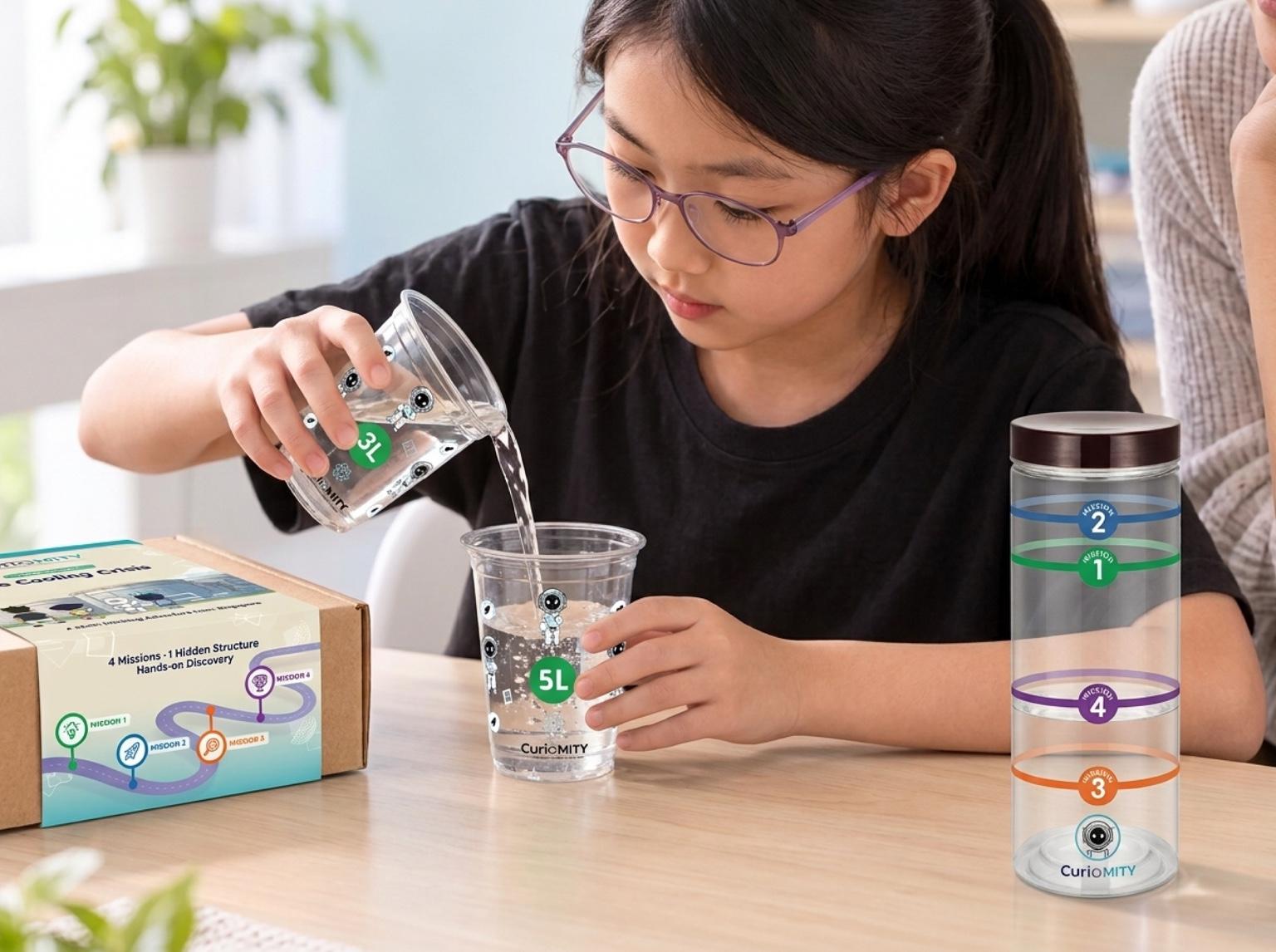
Illustrative CurioMITY experience; final materials may vary.
A capable child may know concepts and methods but still miss the relationship that connects them. Structure Sense is our focus within Mathematical Thinking Development: noticing what matters, what connects and what can be inferred before choosing a method.
It helps children move beyond surface details to make sense of unfamiliar situations. CurioMITY gives them playful opportunities to practise this kind of noticing and reasoning.
How Our Adventures Work ↗What changes? What stays the same?
The habit of looking for relationships comes before choosing a method.
After watching a clear demonstration, can your child explain what is happening and use the idea when the challenge changes? You get to see whether they understood the learning or remembered the steps.
Our promise: help you see how your child thinks.
Through progressively changing missions, your child practises noticing relationships, asking useful questions and trying a first step before asking to be shown.
Our promise: help your child develop thinking without taking away discovery.
One interesting challenge can spark a discovery. A series of changing challenges gives your child repeated opportunities to practise finding a way forward. Each Adventure is one story with four connected missions. Across three Singapore inspired adventures, Curio & Friends turn this practice into a reason to keep exploring.
Two cups. A cooling system to rescue. Four missions explore quantities, constraints and hidden possibilities as the water challenges change.
4 connected missions
A spectacular display depends on getting the balance right. Discover how positions and shared relationships change the answer.
4 connected missions
One packet is different. Only two weighings. Learn to reason through possibilities and eliminate what cannot be true.
4 connected missions
Three Adventures. Four missions in each. Twelve opportunities to practise Seeing Math. Final materials may vary.
Each Adventure combines a story video, hands on materials and four carefully sequenced missions. The demonstration gives every child a starting point. The changed challenges reveal how they use it.
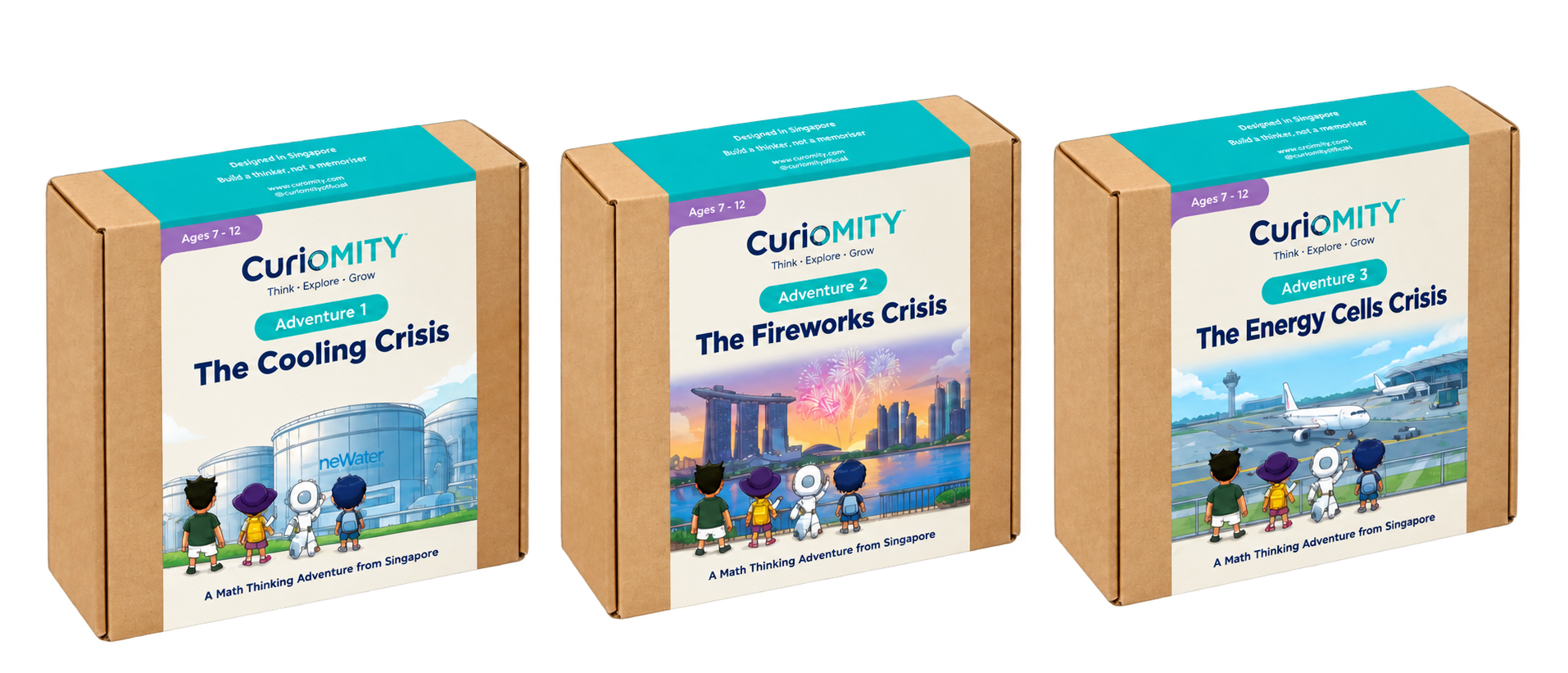
Three adventures. Four missions in each. Final packaging may vary.
Watch Curio & Friends encounter a problem and demonstrate a solution. Like a short lesson in school, your child is first shown an approach. You do not need to teach it.
Your child takes on the mission with real materials. As the quantities and conditions change, you can see whether they understand why the approach works or are repeating the earlier steps.
Each mission asks your child to do more of the noticing and decision making. They work with changing conditions, test an idea and learn from what happens. See the full four mission progression below.
The Parent and Thinking Companions help you interpret an attempt and offer support without revealing the solution. The Child Discovery Journal gives your child space to record and explain discoveries.
For some hardworking students, the difficulty isn't effort or basic knowledge. It's recognising how familiar ideas connect when the presentation changes. This is a possible thinking plateau, not a label or diagnosis.
Following a worked example can feel like understanding, until the details of the question change.
Before selecting a method, children can learn to notice the relationships that give the problem meaning.
Each Adventure scaffolds the move from a demonstrated approach to a new challenge. Familiar steps become less useful unless your child notices the relationships beneath them.
After the simulated lesson, your child carries out the demonstrated challenge. Can they show what each action does?
The quantities or conditions change. Can your child use the idea again, adjusting to what is different?
The situation looks different. Can your child recognise a useful relationship beneath the new details?
The challenge changes again. Can your child reorganise what they know, test a possible first step and adjust?
The purpose of the progression: repeated practice in seeing what matters, connecting ideas and deciding what to try.
One parent was delighted when her son completed the first mission. The next mission helped her see what he had really taken from the lesson.
There are no measuring lines. Children can fill, pour and empty the cups. A child may look at the given sizes, 3 L and 5 L, and wonder how either can produce 4 L.
The useful information is hidden in what the pours create. The demonstration directs attention to two quantities that are not marked on either cup.
The 3 L cup is full. Exactly 2 L remains in the 5 L cup. No measuring line was needed to find it.
The smaller cup now has space for exactly 1 L more. That unmarked gap becomes the next useful piece of information.
Refill the 5 L cup. Pour into the 1 L gap in the smaller cup until it is full. Exactly 4 L remains in the 5 L cup.
The child has moved from staring at the given cup sizes to seeing the hidden 2 L and 1 L relationships that create a solution.
After watching the demonstration, this child could reproduce Mission 1 and show his parent the 4 L. She was pleased that he could do it.
In the next mission, he poured from a full 7 L cup into an empty 4 L cup. He repeatedly explained that 2 L remained, the remainder from the earlier demonstration.
The parent began to question whether he had remembered the first mission’s sequence and result without understanding how the quantities were related.
The changed mission made something visible: was he checking the information in front of him, or carrying an earlier answer into a new situation?
She now had a clearer reason to support his learning. She wanted him to understand what teachers and tutors explained, and to use that understanding more independently when the problem changed.
“I wasn’t aware that my son couldn’t pick up the concept taught in a lesson, and I am concerned that he has been following steps without understanding all these while!”
“This finding is concerning to me but will also lead me to want to spend more time working with him so that he can truly learn independently and understand the lessons teachers and tutors are teaching him.”
One family’s observation, not a diagnosis. The value was seeing how the child responded when the challenge changed.
Independence starts with observable actions, even before your child reaches a correct answer.
Your child looks for a familiar sequence, repeats the old steps or waits for someone to create the starting point.
Your child examines the new information, notices a relationship and tests an idea. If it does not work, they look again and adjust.
This is the thinking CurioMITY gives children opportunities to practise, so they can make better use of what they learn in school and tuition.
The video introduces the challenge. The materials let your child test ideas. Your role is to notice how they respond, and our companions help you make sense of what you see.
You receive practical guidance on when to wait, which questions can keep the thinking with your child, and how to recognise a more independent attempt.
Explore the Founding 300 →You do not have to guess what progress looks like or give away the answer to keep the activity moving.
We want children to approach unfamiliar problems with curiosity and a way to begin. CurioMITY turns that purpose into a planned sequence your family can follow at home.
Each Adventure brings together a simulated lesson, purpose designed materials and four changing missions. The progression gives your child repeated opportunities to use an idea, discover a relationship and adapt an attempt.
You receive the challenges and parent guidance together, so you can support this practice without having to design the activities or reveal the answers yourself.
Explore the Founding 300 →Dr Norman's explanations connect familiar school Math topics to the less visible thinking that helps capable students approach unfamiliar questions.
Learn the difference between knowing a procedure and recognising when it applies.
How the reference quantity changes what a fraction means, even when the arithmetic looks familiar.
Notice how children select information, connect ideas and attempt an independent first step.
Explore these ideas through the Fraction and Average demonstrations above and the parent observation journey.
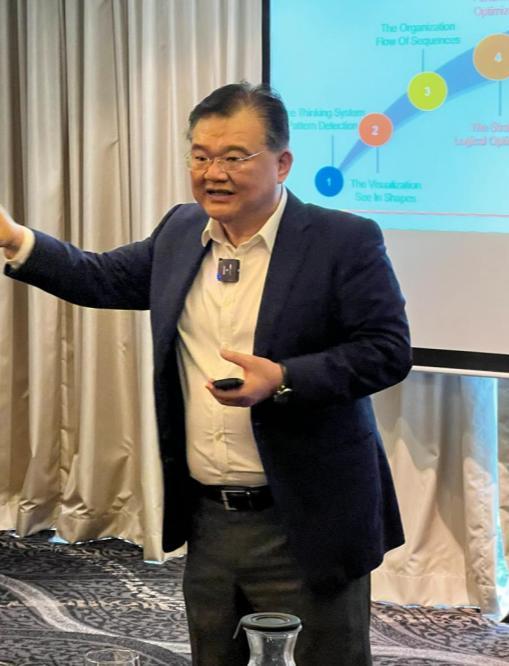
CurioMITY is created by Dr Norman Tien, Math Talent Architect, drawing on Neuromath's experience developing Math thinking programmes, training educators across 60 schools and reaching more than 10,000 students.
That background informs the approach. The CurioMITY adventure journey is designed to make children's thinking visible through real experiences at home.
Neuromath’s educational experience informs CurioMITY; these figures describe Neuromath’s history, not CurioMITY programme outcomes.
CurioMITY brings together Math education, curriculum leadership, psychology informed learning design, storytelling and practical family support.
Led by a former MOE Head of Department for Mathematics, our curriculum team shapes the mathematical challenges and their progression across missions.
Led by a team member with Psychology (Honours) expertise, this group develops the learning experience and guidance that helps parents support discovery.
Storytelling, animation and materials design bring the challenges to life. Our family support team helps parents get started and continue the journey.
Dr Norman has been featured and interviewed on CNA, Channel 8, Capital 95.8 and Money FM.
Founder featured and interviewed on




No. Tuition teaches and reinforces school Math concepts and methods. CurioMITY offers complementary experiences that encourage children to notice relationships, reason and discover. Both can play valuable roles.
It offers opportunities to observe how your child interprets new challenges and whether they rely on understanding or recalled steps. It is not a formal evaluation of teachers, school instruction or a diagnostic assessment of learning.
Yes. Our initial focus is capable, hardworking children who know their concepts and have practised diligently, but may get stuck when a question is unfamiliar or presented differently. It is not a remedial Math programme.
CurioMITY focuses on how children use their knowledge when a challenge changes: noticing relationships, choosing a first step and adapting an attempt. It does not promise a particular examination result. See the programme page for its current offer and terms.
No. The Parent and Thinking Companions help you understand what to observe, when to wait and how to prompt without removing the child’s opportunity to discover.
It is a home based series of physical Math adventures with story videos, four changing missions per adventure and parent guidance. Your child watches, handles materials, tests ideas and explains what they discover.
Time varies with the child and challenge. The aim is thoughtful attempts rather than racing to finish.
Notice whether your child identifies useful information, explains an action, tests a first step and adapts when conditions change. Compare beginning and ending observations; one attempt does not define ability.
CurioMITY is designed as a continuing adventure library. Future adventures are separate purchases; release timing and pricing will be announced when confirmed.
For current international availability and shipping, contact ask@curiomity.com before ordering.
Your child already works hard to learn the Math. Give them repeated opportunities to discover how to use it, when the question changes and no one has shown them the first step.
The greatest educational advantage you can give a child is the ability to see for themselves.
That is why we created CurioMITY.
Help your child See Math. Help them begin for themselves.